Water cooling is significantly more effective than air cooling for power electronics because water has approximately 25 times higher thermal conductivity and 4,000 times greater heat capacity than air. This allows water cooling systems to remove heat more efficiently, maintain lower operating temperatures, and handle higher power densities while requiring less space and energy consumption compared to air cooling solutions.
Overheating components are costing you expensive downtime and premature failures
When power electronics run too hot due to inadequate cooling, semiconductor junctions degrade faster, capacitors dry out, and thermal cycling creates stress fractures in solder joints. This heat damage reduces component lifespan by up to 50% and triggers unexpected shutdowns that can cost thousands per hour in lost production. The solution is to implement proper thermal management that keeps junction temperatures within safe operating ranges, preventing cascade failures and extending equipment life.
Oversized cooling systems are wasting your floor space and energy budget
Air cooling systems require massive fans, heat sinks, and ducting that consume valuable real estate while drawing significant power to move large volumes of air. These bulky installations often struggle to meet cooling demands in compact spaces, forcing engineers to oversize equipment and accept higher energy costs. Switching to liquid cooling eliminates the need for oversized air handling equipment, freeing up space for revenue-generating equipment while reducing cooling energy consumption by 40-60%.
What is the difference between water cooling and air cooling for power electronics?
Water cooling uses liquid coolant to absorb heat directly from electronic components through cold plates or heat exchangers, while air cooling relies on fans and heat sinks to dissipate heat through air convection. Water cooling provides superior thermal performance due to water’s higher thermal conductivity and heat capacity compared to air.
The fundamental difference lies in the heat transfer medium. Air cooling systems move heat away from components using aluminum or copper heat sinks combined with fans that force air circulation. These systems depend on temperature differentials between the component and ambient air, which limits their effectiveness as power densities increase.
Water cooling systems circulate coolant through closed-loop circuits that include pumps, radiators, and cold plates mounted directly on heat-generating components. The liquid coolant absorbs heat more efficiently than air and transports it away from sensitive electronics to external heat exchangers.
Why is water cooling more efficient than air cooling?
Water cooling achieves higher efficiency because water has a thermal conductivity of 0.6 W/mK compared to air’s 0.024 W/mK, allowing faster heat transfer. Additionally, water’s specific heat capacity of 4,186 J/kg·K versus air’s 1,005 J/kg·K means water can absorb significantly more heat energy per unit volume.
This superior thermal performance translates to practical advantages in real-world applications. Water cooling systems can maintain component temperatures 20-30°C lower than equivalent air cooling solutions, even in high ambient temperature environments. The improved heat removal capability allows power electronics to operate at higher power densities without thermal throttling.
Energy efficiency also favors water cooling because pumps require less power than the large fans needed for air cooling systems. A typical water cooling pump consumes 50-100 watts, while air cooling fans for equivalent thermal capacity often require 200-500 watts of electrical power.
What are the main advantages of water cooling systems?
Water cooling systems offer compact design, lower noise levels, precise temperature control, and reduced energy consumption compared to air cooling. They enable higher power densities, provide consistent performance regardless of ambient temperature, and require less maintenance than air cooling solutions with multiple moving fans.
Space efficiency represents a major advantage, particularly in marine and industrial applications where every cubic meter matters. Water cooling systems eliminate the need for large heat sinks and multiple cooling fans, reducing the overall footprint by 60-80% compared to equivalent air cooling installations.
Temperature stability is another key benefit. Water cooling maintains consistent component temperatures even when ambient conditions fluctuate, ensuring reliable operation in challenging environments. This stability prevents thermal cycling stress that can damage sensitive electronic components over time.
When should you choose water cooling over air cooling?
Choose water cooling when power densities exceed 10-15 W/cm², space constraints limit air circulation, ambient temperatures regularly exceed 40°C, or noise levels must remain below 50 dB. Water cooling is also essential for applications requiring precise temperature control within ±2°C tolerances.
High-power applications like grid-scale energy storage, marine propulsion systems, and industrial motor drives typically require water cooling to handle heat loads that would overwhelm air cooling systems. These applications often generate 50-200 kW of waste heat that must be removed efficiently to prevent component damage.
Environmental factors also influence the decision. In dusty or corrosive environments, water cooling protects components better than air cooling because the coolant circuit remains sealed from external contamination. Marine applications particularly benefit from water cooling because salt air can corrode air cooling components and reduce their effectiveness.
How does water cooling improve power electronics performance?
Water cooling improves performance by maintaining lower junction temperatures, which increases semiconductor efficiency, extends component lifespan, and enables higher power output. Lower operating temperatures also reduce thermal noise and improve switching characteristics in power electronic devices.
Temperature reduction directly impacts semiconductor performance because electrical resistance decreases as temperature drops. IGBTs and MOSFETs operating at lower temperatures exhibit reduced conduction losses and faster switching speeds, improving overall system efficiency by 2-5%.
Component reliability increases exponentially with temperature reduction. Following the Arrhenius equation, every 10°C reduction in operating temperature can double component lifespan. This reliability improvement translates to reduced maintenance costs and fewer unexpected failures in critical applications.
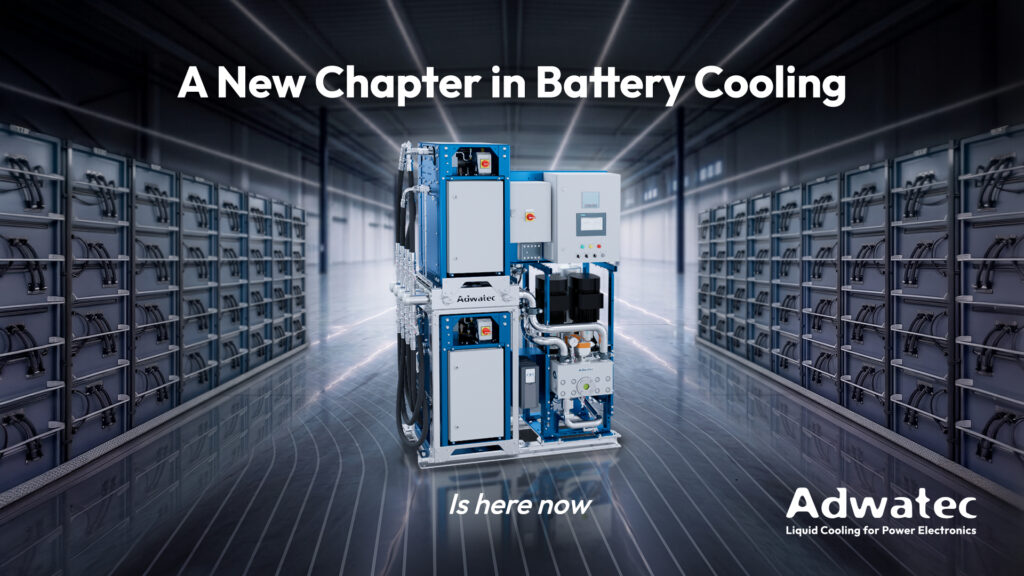
At Adwatec, we have developed specialized cooling solutions for demanding industrial applications over our 25+ years of experience. The marine applications we provide cooling solutions for include propulsion systems, thrusters, winches, and battery and energy storage systems. We provide solutions using primarily the vessel’s technical water system, with seawater as a secondary option when technical water is unavailable. Our modular cooling stations enable precise thermal management that maximizes power electronics performance while minimizing space and energy requirements. Learn more about why you should choose us for your next cooling project.
marine references
-

Ulstein Color Hybrid. Battery cooling for a revolutionary hybrid vessel Adwatec was part of a completely new kind of project within the marine industry when the company won a contract and was to deliver the solution that will cool down the batteries of the world’s largest plug-in hybrid vessel. Key Benefits of Adwatec’s cooling solution:…
-
Water cooling in industrial power grid. Three L-range Adwatec cooling systems take care of SVC applications in industrial power grid. Details about the project:
-

Cooling system for large STATCOM application. Three L-range Adwatec cooling systems take care of STATCOM application in a traction power grid. About the project: