Closed-loop water cooling supports higher power density on ships by removing heat more efficiently from a smaller footprint than air cooling, allowing power electronics to operate at full capacity without thermal throttling. Water carries heat away roughly 25 times more effectively than air, which means components can be packed more densely without overheating. The sections below explore how the system protects electronics, enables denser installations, and improves long-term reliability at sea.
How does a closed-loop water cooling system protect marine power electronics?
A closed-loop water cooling system protects marine power electronics by circulating coolant through a sealed circuit that never contacts the external environment, keeping the cooling medium free from salt, moisture, and contaminants that would otherwise degrade sensitive components. The sealed design isolates electronics from the harshest aspects of the marine environment while continuously drawing heat away from critical parts.
The circuit works by absorbing heat at the component level, transferring it to a heat exchanger, and returning cooled liquid back to the electronics in a continuous loop. Because the coolant stays within the closed system, it remains chemically stable and consistently clean throughout the vessel’s operational life. This matters enormously at sea, where salinity and humidity are constant threats and even minor contamination can cause premature failure in power electronics.
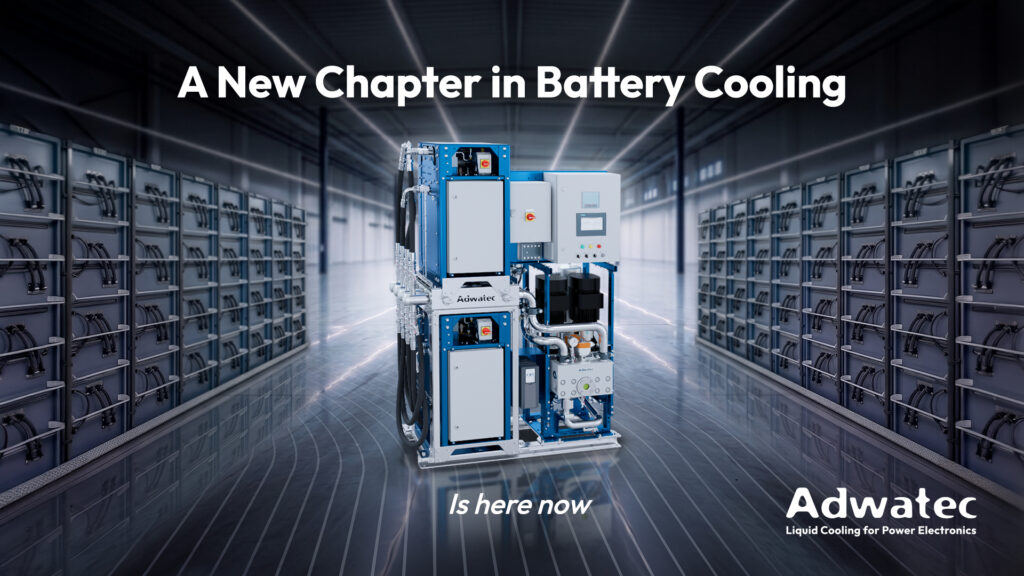
In our marine cooling stations, the heat exchanger transfers thermal energy to the vessel’s own technical water supply, which serves as the primary cooling medium. Seawater is available as a secondary option only when technical water is not accessible. This approach keeps the cooling process reliable and controlled regardless of conditions outside the vessel.
How does closed-loop water cooling support higher power density on ships?
Closed-loop water cooling supports higher power density on ships because water’s thermal conductivity is roughly 25 times greater than air, enabling far more heat to be removed from a compact installation. This allows power electronics to be installed more densely without the risk of thermal throttling, which is the automatic reduction in output that components use to protect themselves when temperatures rise too high.
On a vessel, space is one of the most constrained resources. Air-cooled systems require significant clearance around components for airflow, which limits how tightly equipment can be arranged. A liquid cooling circuit delivers thermal management directly to the heat source, so the surrounding space requirement shrinks considerably. The result is a smaller, more efficient installation that frees up valuable room on board without sacrificing cooling capacity or component performance.
Higher power density also means more capability from the same physical footprint. For modern vessels where propulsion systems, thrusters, winches, and battery and energy storage systems all compete for space, this is a practical advantage that directly affects how a ship is designed and what it can do. Our modular cooling stations are built to enable precisely this kind of compact, high-performance thermal management.
How does a closed-loop water cooling system improve reliability on ships?
A closed-loop water cooling system improves reliability on ships by maintaining consistent, predictable thermal conditions that protect power electronics from the overheating events most likely to cause failure or unplanned downtime at sea. Unlike open-loop systems, which depend on the quality and availability of an external water source, a closed loop recirculates the same carefully managed coolant indefinitely.
This consistency has several practical effects. Coolant quality stays stable, reducing the risk of internal corrosion or scaling that could block flow and degrade performance over time. The system allows for precise chemical treatment of the water, further extending the life of internal components. Fewer moving parts are exposed to contaminants, and there are no air filters to replace, which simplifies maintenance and reduces the number of potential failure points.
Marine environments also subject cooling equipment to vibration, humidity, and rapidly changing ambient conditions that accelerate wear in less robust systems. A well-designed closed-loop system is built to handle these stresses without compromising performance. When power electronics cooling remains stable under these conditions, the entire vessel operates more predictably, and the risk of cooling failure compromising propulsion or other essential systems at a critical moment is significantly reduced.
Why choose Adwatec?
We have been developing and refining marine water cooling solutions since 2007, and our products are currently installed on more than 500 vessels globally. That depth of real-world experience shapes every design decision we make, from component selection to system architecture.
- Proven marine expertise: Over 25 years of water cooling experience, with marine-specific solutions covering propulsion systems, thrusters, winches, and battery and energy storage systems across a wide range of vessel types.
- Modular, customizable design: Our cooling stations are built to be configured for customer-specific needs, so you get a correctly sized solution rather than an oversized one that wastes energy and space.
- Sustainability focus: Compact, energy-efficient designs and eco-mode control reduce operational energy consumption across the system’s lifetime, supporting your vessel’s environmental performance.
- Ease of installation and operation: Marine approvals, straightforward installation, and intelligent automatic controls reduce the burden on crew and engineering teams from day one.
- Competitive lifecycle costs: Fewer maintenance requirements, consistent coolant conditions, and durable construction translate into lower total cost of ownership over the operational life of the vessel.
If you are evaluating liquid cooling options for your next marine project, we are ready to help you find the right solution. Learn why vessel operators choose us for demanding marine cooling applications.