STATCOM systems play a critical role in stabilizing voltage across electrical grids, but the power electronics at their core generate substantial heat under continuous operation. Managing that heat precisely is not optional. Without reliable thermal control, the semiconductors inside a STATCOM can degrade rapidly, reducing system lifespan and increasing the risk of unplanned downtime. Closed-loop cooling has become the standard approach for STATCOM applications because it combines thermal performance with the chemical protection that sensitive power components demand.
This article walks through how a closed-loop cooling circuit functions within a STATCOM system, why deionized water is the preferred cooling medium, and what to consider when sizing and configuring a cooling station for this application.
Why STATCOM power electronics demand precise cooling
STATCOM units rely on insulated gate bipolar transistors (IGBTs) and other high-power semiconductors to perform reactive power compensation. These components operate at high switching frequencies and carry significant current, which means they generate concentrated heat that must be removed continuously and consistently. Even brief temperature spikes above rated limits can cause irreversible damage to semiconductor junctions.
What makes STATCOM cooling particularly demanding is the combination of high heat flux density and the need for electrical isolation. The cooling solution must remove heat efficiently while ensuring that the coolant itself does not create a conductive path between components operating at different voltage potentials. This requirement rules out standard tap water and points directly toward a purpose-built STATCOM cooling system built around a closed-loop circuit with controlled fluid chemistry.
How a closed-loop circuit isolates and protects power components
A closed-loop cooling circuit keeps the coolant in a sealed, recirculating system that never contacts the external environment during normal operation. This isolation is fundamental to protecting power electronics. Because the fluid circulates only within the system, it does not pick up contaminants from outside, and its electrical properties can be maintained at the levels the components require.
In a closed-loop cooling arrangement, the coolant absorbs heat from the power electronics through cold plates or heat exchangers mounted directly on the components. It then carries that heat to a secondary heat exchanger where it is transferred to an external medium, such as air or facility water, before returning to the components again. The primary loop, which touches the electronics, remains chemically stable and electrically safe throughout the process.
Deionized water as the cooling medium in STATCOM systems
Deionized water is the cooling medium of choice in STATCOM applications because of its exceptionally low electrical conductivity. Standard water contains dissolved ions that make it conductive, which poses a direct risk of leakage current and short circuits in high-voltage environments. Deionized water, by contrast, has had those ions removed, giving it the electrical resistivity needed to safely cool components at high voltage potentials.
Deionized water cooling also offers excellent thermal properties. Water has a high specific heat capacity, meaning it can absorb and transport large amounts of heat relative to its flow rate. This makes it far more efficient than air cooling for the heat densities found in STATCOM installations. However, deionized water is chemically aggressive toward certain metals, so the materials used throughout the cooling circuit, including pipes, fittings, and heat exchangers, must be carefully selected to resist corrosion and avoid reintroducing ions into the loop.
Maintaining the resistivity of the deionized water over time requires an ion exchange resin bed within the cooling station. As the water gradually picks up ions from system components, the resin bed continuously strips them out, keeping conductivity within safe limits without requiring manual intervention between service intervals.
Key components of a STATCOM cooling station
A cooling station for STATCOM applications integrates several functional elements into a single, engineered package. Each component has a specific role in maintaining the thermal and chemical conditions the power electronics require.
- Circulation pump: Moves deionized water through the primary loop at the flow rate needed to meet the heat load of the STATCOM unit.
- Primary heat exchanger: Transfers heat from the deionized water loop to a secondary medium, typically facility water or an air-cooled condenser, without allowing the two fluids to mix.
- Ion exchange unit: Continuously polishes the deionized water to maintain the required resistivity throughout operation.
- Expansion vessel: Accommodates volume changes in the coolant as temperature fluctuates, keeping the system at the correct pressure.
- Instrumentation and controls: Monitor flow rate, temperature, pressure, and conductivity, and can trigger alarms or protective actions if parameters drift outside acceptable ranges.
Together, these components form a closed-loop cooling circuit that operates autonomously once commissioned, requiring minimal intervention during normal service.
Sizing and configuring cooling stations for STATCOM installations
Getting the sizing right is where engineering precision directly translates into long-term reliability. An undersized cooling station cannot remove heat fast enough during peak load, while an oversized unit wastes energy and increases capital cost. The starting point is always the total heat dissipation of the STATCOM unit, which the equipment manufacturer provides as part of the technical specification.
Beyond raw cooling capacity, the configuration must account for the ambient conditions at the installation site, the available secondary cooling medium, and any redundancy requirements. Grid-connected STATCOM systems often operate in environments where continuous availability is critical, so many installations include redundant pumps or dual cooling circuits to ensure that a single component failure does not interrupt operation.
Modular cooling station designs offer a practical advantage here. Rather than engineering a bespoke solution from scratch, modular platforms allow the cooling station to be configured around the specific parameters of each STATCOM installation, combining standardized, proven components in the arrangement that fits the application. This approach reduces lead time, simplifies commissioning, and makes future maintenance more straightforward because spare parts are consistent across configurations.
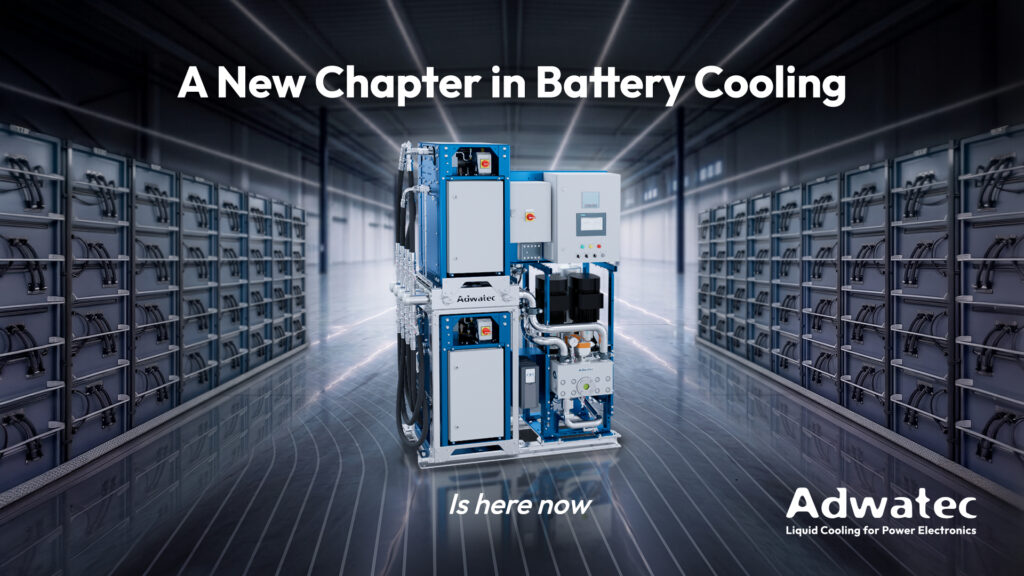
At Adwatec, we design and supply water cooling stations specifically for demanding power electronics cooling applications, including STATCOM systems. Our L series cooling stations are built for deionized water cooling in grid applications such as Static Var Compensators, and our modular product platform means each solution is sized and configured to match the actual requirements of the installation. With more than 25 years of water cooling experience and solutions currently cooling 5,000 MW of customers’ power electronics worldwide, we bring both the technical depth and the practical track record that grid infrastructure projects require. If you are working on a STATCOM project and want to explore cooling options, we are happy to help you find the right configuration.