STATCOMs (Static Synchronous Compensators) have become a cornerstone of modern power grids, providing fast reactive power compensation that keeps voltage levels stable across transmission and distribution networks. As grids absorb more renewable energy and face increasingly dynamic load conditions, the role of STATCOMs grows more critical every year. But behind every reliably operating STATCOM is a thermal management system working quietly in the background.
STATCOM cooling is not a secondary consideration — it is a fundamental requirement for grid reliability, and getting it right makes the difference between a system that performs and one that fails under pressure.
How STATCOMs generate heat during grid operation
STATCOMs regulate reactive power by rapidly switching high-power semiconductor devices, typically IGBTs (Insulated Gate Bipolar Transistors) or similar components. Every switching cycle generates heat as a byproduct of conduction and switching losses. In a system that may switch thousands of times per second under full load, this thermal output accumulates quickly and concentrates in a relatively small physical space.
The power electronics inside a STATCOM can generate substantial heat loads, and the semiconductors themselves are highly sensitive to temperature. Even moderate thermal stress, sustained over time, accelerates component aging and increases the probability of failure. Effective STATCOM thermal management is therefore not just about preventing immediate overheating — it is about protecting the long-term integrity of the entire system.
Why inadequate cooling threatens grid stability
When cooling falls short, the consequences extend well beyond the STATCOM unit itself. Overheated power electronics can trigger protective shutdowns, removing reactive power support from the grid at exactly the moment it is needed most. Voltage instability, cascading faults, or even blackouts can follow in grid segments that depend on STATCOM compensation.
In applications such as wind farms, industrial power supply networks, or HVDC converter stations, a STATCOM outage can disrupt operations with significant economic and safety implications. Adequate power electronics cooling is therefore directly tied to grid reliability — not as a supporting function, but as a core operational requirement. Thermal failures are among the leading causes of power electronics downtime, and most of them are preventable with the right cooling design from the start.
Closed-loop water cooling vs. air cooling for STATCOMs
Air cooling was once the standard approach for power electronics, but it struggles to keep pace with the heat densities found in modern STATCOMs. Air has a low heat capacity, which means large volumes of airflow are needed to remove meaningful amounts of heat. This translates into large enclosures, noisy fans, and significant energy consumption, particularly in outdoor or industrial environments where ambient temperatures can vary widely.
Closed-loop water cooling offers a fundamentally different approach. Water carries heat far more efficiently than air, allowing compact cooling circuits to handle high thermal loads without oversized equipment. In a closed-loop system, the coolant circulates within a sealed circuit, removing heat from the power electronics and transferring it to a secondary heat exchanger. This keeps the coolant clean and free from contamination, which is especially important for water cooling STATCOM applications where de-ionized water is required to prevent electrical conductivity issues near live components. The result is a quieter, more energy-efficient, and more reliable cooling solution compared to air-based alternatives.
Key requirements for a reliable STATCOM cooling system
A STATCOM cooling system must meet several non-negotiable requirements to support continuous, uninterrupted grid operation. The most critical of these is consistent coolant temperature control — the system must maintain semiconductor junction temperatures within safe operating limits across all load conditions and ambient environments.
Beyond temperature control, the following requirements define a robust design:
- De-ionized water compatibility: Many STATCOMs require de-ionized (DI) water to prevent current leakage through the coolant. The cooling station must be built with materials that are chemically compatible with DI water over the long term.
- Redundancy and monitoring: Sensors for flow rate, pressure, temperature, and conductivity allow early detection of anomalies before they become failures. Redundant pump configurations prevent single points of failure.
- Pressure and flow stability: Stable hydraulic conditions protect sensitive components and ensure uniform heat removal across all parallel cooling paths.
- Low maintenance design: Grid infrastructure is expected to operate for decades. A cooling system that minimizes service interventions reduces lifecycle costs and operational risk.
These requirements are well-established in reactive power compensation cooling practice, and they inform the engineering decisions that separate purpose-built cooling stations from generic industrial solutions.
How modular cooling stations simplify STATCOM projects
One of the practical challenges in STATCOM projects is that each installation has its own specific requirements — different power ratings, footprint constraints, ambient conditions, and integration interfaces. A rigid, one-size-fits-all cooling unit rarely fits cleanly into these realities. Modular cooling stations address this by providing a configurable platform that can be adapted to project-specific needs without requiring a full custom engineering effort.
Modular designs allow engineers to select the right pump configuration, heat exchanger capacity, and control features for each application, while working within a proven product architecture. This reduces engineering lead time, simplifies procurement, and lowers installation complexity. For STATCOM projects where timelines are tight and technical specifications are demanding, this flexibility has real practical value.
Compact, correctly sized cooling stations also reduce the overall footprint of the installation and consume less energy than oversized systems running at partial load. Features such as eco-mode control, which adjusts cooling output to actual thermal demand, further contribute to efficient long-term operation. As grid projects increasingly face scrutiny on energy efficiency and sustainability, these characteristics matter beyond the technical specification sheet.
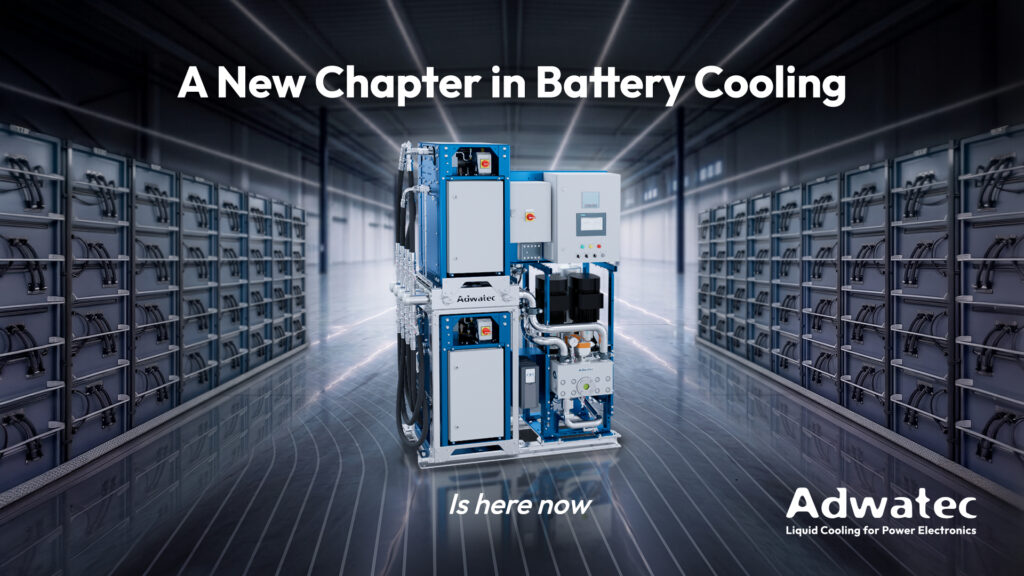
At Adwatec, we have been designing and delivering water cooling solutions for power electronics since 2007, with installations cooling over 5,000 MW of customers’ power electronics across power grid, marine, and industrial applications worldwide. Our L series cooling stations are built specifically for demanding de-ionized water cooling systems used in applications such as Static Var Compensators and STATCOMs, and our modular product range allows us to configure solutions that fit the precise requirements of each project. If you are working on a STATCOM installation and want to explore how a purpose-built cooling station can support your design, we are happy to help.