Utility-scale STATCOM installations push power electronics hard. Switching devices like IGBTs and gate-controlled thyristors generate significant heat during reactive power compensation, and keeping that heat under control is fundamental to system availability, component lifespan, and grid reliability. Closed-loop liquid cooling has become the preferred thermal management approach for these applications precisely because it combines high cooling capacity with the electrical isolation and environmental protection that high-voltage grid equipment demands.
This article walks through the thermal challenges of utility-scale STATCOM systems, explains how closed-loop cooling circuit design addresses them, and covers the practical considerations that matter when selecting and operating a cooling station in a grid environment.
Thermal demands of utility-scale STATCOM systems
STATCOM systems used in utility grids operate continuously, often at high load factors, and must respond dynamically to voltage fluctuations on the network. This creates a demanding and variable thermal profile. The power semiconductors at the heart of a STATCOM module can generate heat loads ranging from tens to hundreds of kilowatts depending on system rating, and even brief thermal excursions above rated junction temperatures accelerate device degradation.
Unlike conventional resistive loads, the heat generated in STATCOM power stacks is concentrated in a relatively small physical footprint. Effective STATCOM thermal management therefore requires a cooling medium capable of moving large amounts of heat away from tight spaces quickly and reliably. Water transfers heat far more efficiently than air, which is why liquid cooling at this scale is not just an option but a practical necessity for larger power electronics installations.
How closed-loop cooling isolates and protects power electronics
A closed-loop liquid cooling system circulates coolant in a sealed circuit that never contacts the outside environment directly. This isolation is critical in high-voltage applications. Because the coolant loop is closed, it can be maintained at a controlled purity level, which is essential when coolant flows directly through or adjacent to live electrical components.
In STATCOM applications, the inner loop typically uses deionized water to ensure the coolant remains electrically non-conductive. This prevents leakage currents that could damage sensitive electronics or create safety hazards. The closed-loop design also protects against contamination from airborne particles, moisture ingress, and biological growth, all of which are real concerns in outdoor or industrial grid substations. The result is a thermally efficient, electrically safe, and low-maintenance cooling architecture that suits the long operational cycles expected of grid infrastructure.
Key components of a STATCOM liquid cooling station
A liquid cooling station for STATCOM service is more than a pump and a heat exchanger. Each component plays a defined role in maintaining stable coolant conditions across the full operating range of the system.
Circulation and pressure management
The pump circuit maintains consistent coolant flow through the power stack. Flow rate and pressure must be matched to the thermal resistance of the cold plates or heat exchangers fitted to the semiconductors. Variable-speed drives on the pump allow flow to be adjusted to the actual heat load, reducing energy consumption during partial-load operation.
De-ionization and water quality control
Maintaining the electrical resistivity of de-ionized water requires continuous monitoring and an ion exchange resin circuit. As coolant picks up ions from piping and component surfaces over time, the resin bed removes them, keeping resistivity within the specification required to prevent leakage currents. Conductivity sensors and automatic bypass valves are standard features in well-designed cooling stations for this duty.
site.
Sizing and selecting a cooling system for grid applications
Getting the sizing right is where engineering decisions have the most impact on long-term performance and cost. An undersized cooling station risks thermal shutdown during peak grid events; an oversized one wastes capital and energy.
The starting point is the total heat dissipation figure from the STATCOM manufacturer, expressed in kilowatts, along with the maximum allowable coolant inlet temperature to the power stack. Ambient conditions at the installation site matter significantly: a substation in a hot climate requires a larger heat rejection margin than one in a temperate region. Altitude also affects air-cooled heat rejection performance and should be factored in for dry cooler sizing.
Operational considerations and long-term reliability
A cooling station installed at a grid substation may be expected to operate for 20 years or more with minimal intervention. Reliability engineering therefore starts at the design stage. Redundant pump sets, automatic switchover on fault detection, and remote monitoring capability are features that significantly reduce the risk of unplanned downtime.
Routine maintenance requirements should be understood before commissioning. De-ionization resin beds have a finite service life and need periodic replacement. Glycol concentration in circuits exposed to frost risk requires seasonal checking. Filter elements protect the pump and cold plates from particulate contamination and need scheduled inspection. When these tasks are planned and documented, the total maintenance burden is manageable and predictable.
Energy efficiency over the operational life of the system is also worth considering at the selection stage. Cooling stations with eco-mode control can reduce pump and fan speed during periods of lower heat load, cutting auxiliary power consumption meaningfully over a year of operation. For grid operators managing their own auxiliary power budgets, this is a tangible benefit that compounds over the system lifetime.
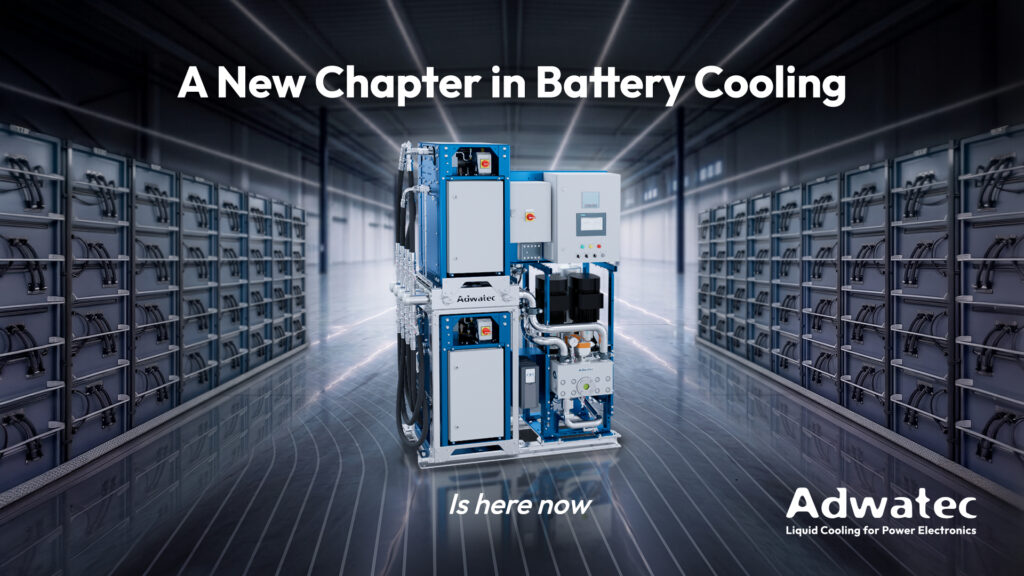
At Adwatec, we design and manufacture closed-loop liquid cooling stations specifically for demanding power electronics applications, including utility-scale STATCOM and other grid infrastructure. With over 25 years of water cooling experience and installations cooling more than 5,000 MW of customers’ power electronics worldwide, we bring both the technical depth and practical track record that grid-scale projects require. Our modular cooling station platform, including the L series designed for deionized water applications, allows us to configure solutions that match the exact thermal and electrical requirements of each project. If you are specifying a cooling system for a STATCOM installation, we are happy to work through the requirements with you.